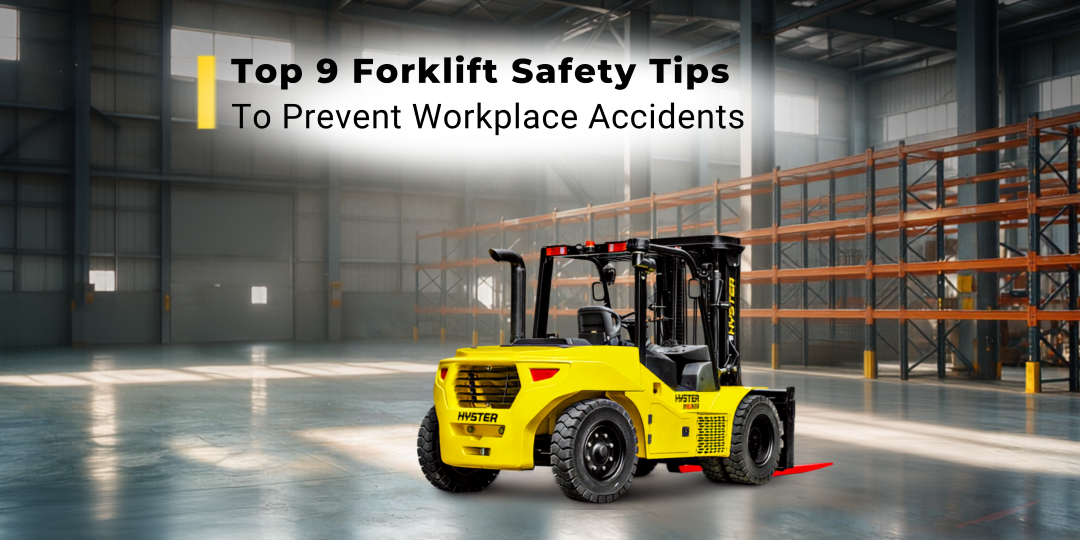
In Indian manufacturing plants, warehouses, logistics hubs, construction sites and distribution centres, you can find forklifts. They are used across environments where people, storage racks, trucks, and other equipment share limited space. This machine can move heavy loads quickly and efficiently, but even a small operating error can have serious consequences.
Safety, therefore, cannot be treated as something that begins and ends with the operator. Effective forklift safety depends on three critical elements:
- a competent operator,
- a properly maintained machine,
- And, a workplace designed for the movement of people and materials safely.
Indian workplaces also need to consider the applicable manufacturer instructions, site-specific safety procedures and relevant Indian Standards for industrial trucks. You might be aware that BIS has standards covering different types of industrial trucks and their safety requirements, including counterbalanced and rough-terrain forklifts.
Here are 9 practices that can make forklift operations safer without turning safety into a checklist:
Table of Contents
- Start with the operator, not the machine
- Give the forklift a check before giving it a job
- Know what the forklift is actually lifting
- Treat every load as a stability problem
- Slow down before the situation gets adverse
- Make pedestrians part of the safety plan
- Respect the blind spots
- Give Importance to the ramps and loading docks
- Use safety equipment
- Don't wait for a breakdown to maintain the forklift
1. Start with the operator, not the machine
A forklift may be technically capable of lifting a particular load, but that does not mean every person in the facility should be allowed to operate it. Forklift operators’ safety starts with operator competence.
Training needs to go beyond learning. Operators should understand:
- How the machine behaves when carrying different loads
- How the centre of gravity changes during lifting
- How to approach ramps and corners
- And, how to operate safely when visibility is restricted.
This becomes particularly important when an operator moves between different forklift models or working environments. A machine used inside a narrow warehouse may behave very differently while working outdoors on uneven industrial surfaces. Thus, training should reflect the actual machine and the actual workplace.
Moreover, if there is a change in equipment, workplace layout, or operating conditions, then the operator must again go through training.
2. Give the forklift a check before giving it a job
The first few minutes of a shift can tell an operator a lot about the condition of a forklift.
A pre-use inspection should look for anything that could affect safe operation; start with:
- Damaged forks
- Worn-out tyres, steering, brakes, and hydraulics
- Technical faults in the warning devices
- Visible leaks.
The exact inspection procedure should follow the manufacturer's recommendations and the site's established safety process.
The important part is what happens after a problem is found. A defect should not become a “we'll get it repaired later” issue simply because production is busy. An unsafe forklift needs to be reported and dealt with before it returns to service.
Moreover, detecting a developing problem early can prevent an accident as well as an unexpected equipment downtime.
3. Know what the forklift is actually lifting
One of the most dangerous assumptions in material handling is that a forklift can safely lift anything that fits its forks.
Every forklift has a rated capacity, but the safe capacity is influenced by more than the weight of the load. Load centre, attachment, lift height, and the way the load is positioned can all affect stability. Thus, you must never ignore the capacity information provided on the machine.
You must consider a load that weighs less than the forklift's maximum rated capacity. Safe forklift operation therefore means understanding the relationship between the machine and the load, rather than simply asking, “Can it lift this?”
4. Treat every load as a stability problem
A forklift does not become safer simply because its load has been picked up successfully. The load needs to remain stable throughout the movement. Poorly arranged material, an uneven pallet or a load that shifts during travel can create a hazard even when the forklift itself is functioning perfectly.
Operators should assess the load before lifting it and position the forks appropriately. Once lifted, the load should be carried at a safe height and in accordance with the manufacturer's operating instructions.
This matters especially in Indian warehouses and industrial facilities where forklifts may move everything from cartons and pallets to steel products and heavy industrial components.
5. Slow down before the situation gets adverse
Safe forklift operation is not simply about complying with a posted speed limit. For a forklift operator, travelling too quickly for the surroundings can be just as dangerous as exceeding a formal site speed limit. A crowded aisle, wet floor, sharp turn, pedestrian crossing or blind intersection all require a different approach.
Good operators read the environment and adjust accordingly. They slow down before turning rather than during the turn. They avoid sudden acceleration and braking and remain particularly cautious around ramps, loading areas, and uneven surfaces.
The objective is not to make material handling unnecessarily slow. It is to create a predictable movement pattern in which the operator always has enough control to respond to what happens next.
6. Make pedestrians part of the safety plan
A forklift and a pedestrian should never have to rely on luck to avoid each other.
Warehouses and factories are dynamic environments. Employees walk between workstations, supervisors cross operating areas; maintenance personnel enter equipment zones, and drivers move between vehicles. At the same time, forklifts may be reversing, turning or carrying loads.
The solution is not simply telling everyone to “be careful”. The workplace should be designed to reduce interaction wherever possible.
Indian warehouses can be particularly challenging when available space changes as inventory levels fluctuate. Clearly defined pedestrian paths, suitable barriers, marked crossings, mirrors at blind corners, adequate lighting and appropriate warning systems can all help create separation.
7. Respect the blind spots
One of the simplest rules of forklift safety is also one of the easiest to forget: if you cannot see the path clearly, you should not assume it is clear.
Tall racks, stacked goods, containers, doorways and large loads can all create blind spots. Instead of relying on the horn as a substitute for visibility, operators should reduce speed, assess the area, and follow the site procedure for dealing with restricted visibility.
Where the load blocks forward visibility, the appropriate method of travel should be determined by the forklift manufacturer's instructions and the conditions of the workplace.
A few extra seconds at a blind corner are insignificant compared with the consequences of a collision.
8. Give Importance to the ramps and loading docks
A level warehouse floor and a loading dock are not the same operating environment.
Ramps change the way a forklift and its load behave. Loading docks introduce additional risks involving edges, dock plates, trailers, and differences in elevation. These areas deserve slower movement and greater attention to the condition of the surface and the equipment involved.
Before entering a dock or ramp, operators should ensure that the route and equipment are suitable for the combined forklift and load. Safe distances from edges should be maintained, and the site loading and unloading procedure should always be followed.
9. Use safety equipment
Seat belts, operator restraints, warning devices, overhead guards and other safety features are fitted for a reason. Thus, you should never treat them as optional accessories.
The same principle applies to personal protective equipment. Now, depending on the workplace, operators may need safety footwear, high-visibility clothing, helmets, eye protection or other PPE specified by the site's risk assessment.
Also, supervisors therefore have an important role in ensuring that safety requirements are followed consistently, including during periods of high production pressure.
Don't wait for a breakdown to maintain the forklift
Maintenance is often viewed through the lens of productivity: keep the forklift running and avoid downtime. But, preventive maintenance has an equally important safety purpose.
Ultimately, a strong forklift safety culture is more valuable than a safety poster on the warehouse wall.
A practical reminder for operators and supervisors - before the next shift begins, ask three simple questions:
- Is the machine fit to work?
- Is the load safe to move?
- Is the path safe to travel?
If the answer to any of these is uncertain, stopping for a few minutes is not losing productivity; rather, it is responsible material handling.