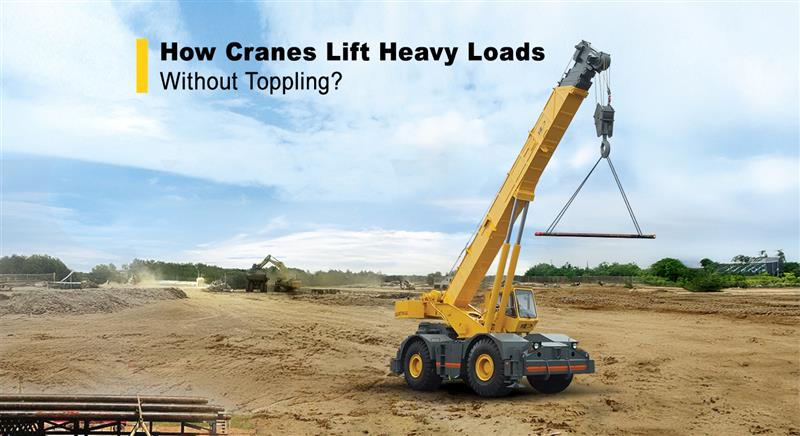
When a massive tower crane is lifting multi-ton loads at a construction site, or a Rough Terrain crane is working at a mining site, it looks effortless. However, behind that precision lies a combined effect of engineering, physics, and human expertise. The question “How do cranes lift heavy loads without toppling?” is one of the most asked questions on any construction safety forum.
So, let’s break down science, systems, and real-world practices. This will help you to understand what keeps cranes stable and safe across the globe.
Table of Contents
6 Core Reasons Why Cranes Do Not Topple
1. The Physics Behind Crane’s Stability
The one concept that defines why a crane does not topple is “Moment balance”. When a crane lifts a load, it creates a tipping moment, which is a rotational force, and it can overturn the machine.
Now, the crane must generate an equal and opposite resisting moment which would prevent toppling. The three main factors that generate the resisting force are:
- The weight of the crane and its counterweights
- The radius of the load from the crane's center of rotation
- The weight of the lifted or suspended object
Every crane has a center of gravity, the point where its total mass is concentrated. As the boom extends or the load swings, the center of gravity shifts. So, if the crane must remain stable, then a combined center of gravity of the crane and the load must stay within the base of support. If there is a shift beyond the base, the crane begins to tip.
Thus, you need to refer to the crane load charts. They define exactly how much a crane can lift safely within permissible limits at specific angles and boom lengths.
2. Counterweights
To counterbalance the load, the counterweights are positioned across from the boom. Now, when a crane is lifting a large object, the counterweight system helps to maintain the balance by moving the center of gravity back toward the base.
To optimise the balance in real time, some contemporary cranes even feature adjustable counterweights that automatically adjust as the boom extends. This idea explains why cranes are not only sturdy but also finely balanced, allowing them to raise heavy loads without toppling.
3. Outriggers and Ground Stability
Outriggers are necessary for most of the cranes, especially truck-mounted and mobile cranes. By raising the chassis just a little bit predefined height off the ground, these extensible legs improve base stability and width.
However, uneven topography, soft soil, or subterranean spaces might not be suitable for placing outriggers, and this can compromise the entire system. This is where trained operators are required; they have the technical knowledge to uniformly distribute the weight using cribbing or outrigger matting. Thus, prior to deployment, you need to always conduct a site inspection.
4. Importance of Crane Load Charts
Every crane comes with a load chart, which is the operator’s safety bible. It specifies how much weight the crane can lift safely, depending on the boom length, angle of radius from the crane’s center of rotation, and counterweight setup.
For example, a TIL Limited RT740 B crane that can lift 40 tons at a 3-m radius might. When the boom length is 10.6 m, it can lift 31 tons at 3.5-m, with the same boom length. The farther the load, the greater the tipping moment, and the smaller the safe capacity.
Thus, operators must undergo proper certification to read and interpret these load charts accurately.
5. Dynamic Forces - Wind, Swing, and Movement
Lifting isn’t just about static weight; it is dynamic stability. Wind gusts, load swings, and sudden movements all introduce side forces that can destabilise a crane.
Even moderate wind speeds can create massive sideways pressure on large surface areas like panels or containers. That’s why most lift plans include wind speed limits and load swing control. Ignoring these forces is one of the top causes of crane tip-overs globally.
6. The Role of Smart Technology
Modern cranes are equipped with Load Moment Indicators (LMIs) and Rated Capacity Indicators (RCIs). These systems monitor the crane’s load, boom angle, and radius in real time.
If the lift approaches the maximum safe limit, the system automatically warns or halts the operation. Some cranes even have automatic levelling systems and boom angle sensors to minimise human error further.
While these tools greatly improve safety, human judgment remains irreplaceable.
Common Causes of Crane Tip-Overs
Even with advanced systems, accidents can happen when procedures aren’t followed. The most common causes of crane tip-overs include:
- Exceeding the rated capacity in overloading
- Weak ground or improper outrigger configuration
- Strong wind or side loading
- Lack of periodic maintenance and use of non-OEM parts
- Improper lift planning or rigging
- Operator error or fatigue
With proper training, preparation, and equipment inspections, these causes can be avoided, preventing crane toppling.
Conclusion
How do cranes lift heavy loads without toppling? It’s all about balance, preparation, and precision. From counterweights to outriggers, load charts to real-time monitoring, every element of a crane’s design works toward one goal - “keeping the center of gravity within the base of support”.
Crane safety is universal. Whether you’re in Dubai, Delhi, or Dallas, the laws of physics don’t change. So, the next time you see a tower crane moving steel or a truck crane hoisting equipment at an industrial site, remember it’s a combined outcome of engineering intelligence and physics. Along with this, experienced operators help to keep the crane upright.
At TIL Limited, we know the risks of using non-OEM parts. That’s why we provide only genuine parts, annual maintenance contracts, and operator training sessions. Contact us to learn more about our product range.
FAQs
1. Why is the crane hook sometimes rated lower than the crane capacity?
The crane hook is sometimes rated lower than the crane capacity because hook capacity considers its own geometry and load direction, not total crane balance. The overall crane system is rated separately.
2. What is the use of outriggers?
Outriggers help to increase the footprint, but ground strength still matters. Even reinforced outriggers can fail if the soil is muddy.
3. Can you lift a load to the maximum load chart capacity?
Not necessarily. Engineers recommend operating below the limit to adjust the interferences for unexpected dynamic forces or wind gusts.