
In 2026, India’s infrastructure growth is unfolding at a rapid pace. Highways are expanding, metro networks are connecting smaller cities, power projects are accelerating, and industrial zones are spreading beyond traditional hubs. Here, supporting this progress is equipment that rarely draws attention, and one such machine is the truck crane.
A familiar sight inside factories is practical and highly mobile truck cranes, or even in congested urban areas, where space is limited, and speed is essential.
In this blog, let’s look at five real-world applications where truck cranes are actively shaping infrastructure across India in 2026.
Table of Contents
Why Truck Cranes Matter?
India’s construction and industrial landscape presents unique challenges. When projects move fast, sites get congested, and equipment must travel long distances across varied road conditions. Truck cranes address these challenges efficiently.
According to the IMARC report, it is expected that the Indian truck crane market will grow at a CAGR of 9.4% during 2025-2033, reaching a volume of 21,482 units by 2033.
By combining road mobility with strong lifting capability, they can travel on public roads, set up quickly on-site, complete heavy lifts, and move on without the need for trailers or additional logistics. For contractors and infrastructure developers, this results in faster execution, lower operating costs, and better control over project timelines.
1. Highway and Bridge Construction
Highway and bridge projects remain one of the most common applications. These cranes are used for placing precast girders, lifting shuttering material, and handling heavy components for road construction.
In semi-urban and rural locations, transporting crawler cranes can be difficult, and so truck cranes offer a practical alternative. They have the ability to perform lifts without disrupting traffic for long periods.
2. Power and Energy Infrastructure
Power projects place constant and varied lifting demands. In substations, these cranes are used to install transformers, switchgear, and structural components, often in confined spaces with limited access.
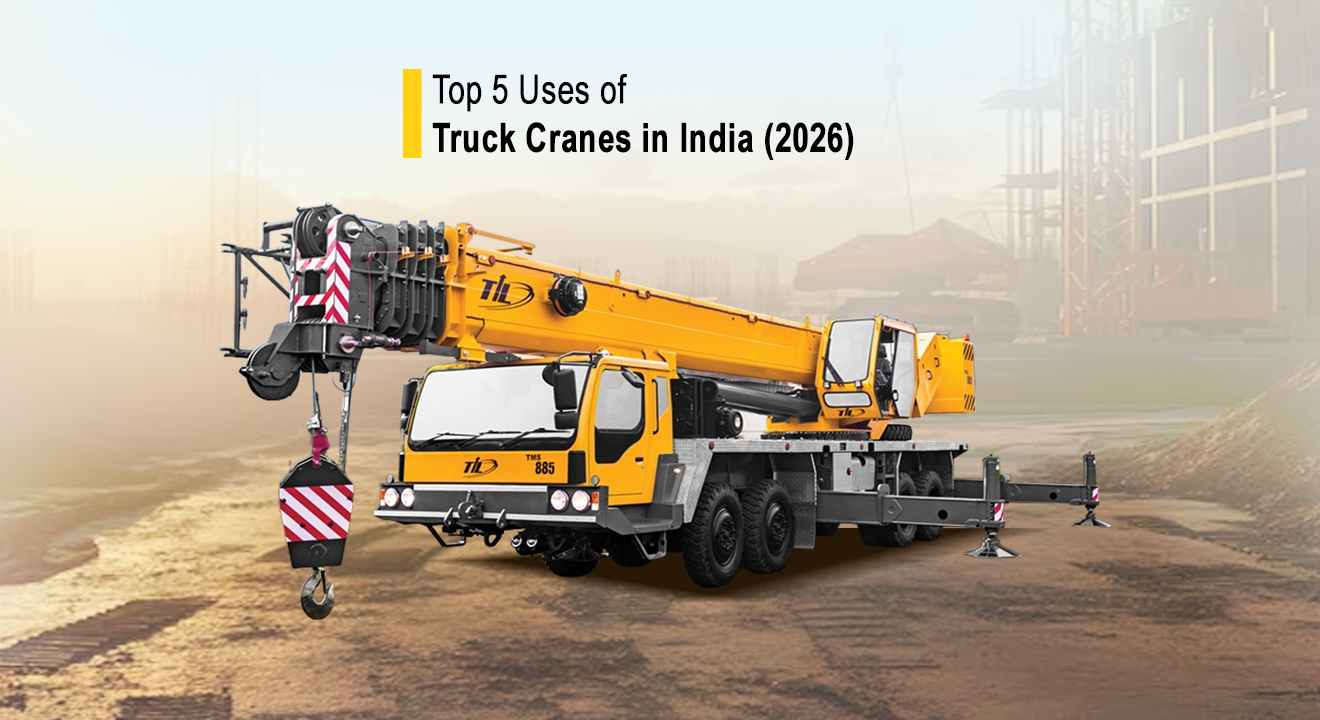
Their mobility and stable carrier platforms make them suitable for sites that lack extensive groundwork. For example, the heavy-duty 8×4 carrier of the TIL TMS 885 has outriggers to provide reliable stability even on partially prepared surfaces.
The growing renewable sector further increases reliance on mobile lifting solutions. Wind, solar, and energy storage installations require cranes with long reach and consistent performance. A 5-section power boom with up to 43.8 metres of reach, and an additional 63m with lattice, supported by a 260 HP engine, ensures dependable operation where downtime can be costly.
3. Urban Infrastructure and Metro Projects
The metro rail systems, elevated corridors, sewage treatment plants, and smart city projects are becoming part of everyday urban life. These sites require equipment that can operate within tight spaces and adhere to strict time windows. Truck cranes fit these requirements well.
In such environments, precision and control matter more than sheer lifting force. Features like full slew control and stable carriers make these cranes a preferred choice for metro contractors and urban infrastructure developers.
4. Industrial Plants and Manufacturing Facilities
Inside large industrial plants, truck cranes are frequently used for equipment installation, relocation, and maintenance. When compared with overhead cranes, which are fixed, they offer flexibility and can be deployed temporarily without modifying permanent infrastructure.
Industries such as steel, cement, refineries, automotive, and heavy engineering rely on truck cranes to lift presses, turbines, vessels, and large assemblies. Their ability to operate both indoors and outdoors adds to their versatility.
With higher-capacity models, TMS 885, now available at TIL Limited, industries can manage heavier machinery without hiring multiple equipment.
5. Emergency Response and Heavy Recovery
Emergency response is a less visible but highly critical application. In cases where there is structural failure, a vehicle overturns, or on-site equipment breakdowns, truck cranes are often among the first machines deployed to lift the for heavy loads.
Their road mobility enables quick access to highways, ports, and industrial zones, where they assist in clearing obstructions and restoring operations. During natural disasters such as floods or cyclones, they play a key role in debris removal, equipment recovery, and temporary infrastructure repairs.
How Indian Manufacturers Are Raising Standards?
The Indian crane market has matured significantly. Customers now expect higher capacity, improved safety systems, and dependable after-sales support. Machines like the TMS 885 from TIL Limited reflect this evolution.
With an 85-tonne lifting capacity, 360° slew control, 5-section power boom, 63 m reach with lattice, 260 HP engine, and a heavy-duty 8×4 carrier, it is designed specifically for India’s demanding operating conditions. Its versatility allows contractors to cover multiple applications with fewer machines, improving utilisation and return on investment.
While these tools greatly improve safety, human judgment remains irreplaceable.
Looking Ahead: 2026 and Beyond
As India continues its infrastructure and industrial expansion, the need for efficient, mobile lifting solutions will only grow. Projects are becoming larger, timelines are tighter, and safety expectations are higher.
Truck cranes are no longer just support equipment. They are core assets enabling progress across highways, power projects, cities, factories, and emergency operations. In real-world conditions where flexibility and reliability matter most, their value continues to be proven every day.