
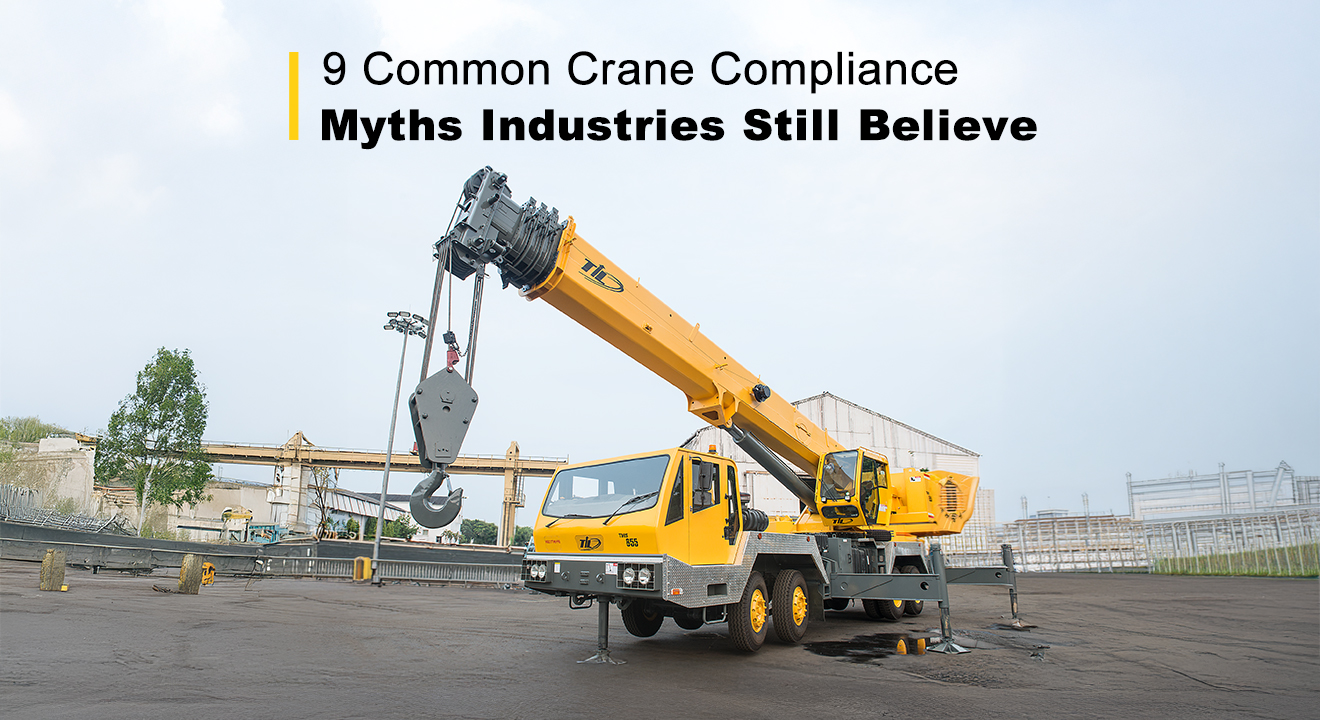
Crane compliance in India is governed by a combination of national regulations, international standards, and industry best practices. Despite this, across multiple sectors such as construction and infrastructure, some organisations still rely on outdated assumptions about compliance and safety.
These misconceptions can lead to serious consequences. Safety guidance from regulators and international safety bodies commonly identifies planning, inspection, maintenance, training, competency, and operational control as major contributors to crane incidents, and not just equipment design.
This blog addresses 9 common myths and explains why safe, compliant crane operations matter.
Table of Contents
- Myth 1: If a crane can lift the load, it is compliant
- Myth 2: Crane compliance is a one-time certification
- Myth 3: Compliance only matters during audits
- Myth 4: Experienced operators make cranes compliant
- Myth 5: Imported cranes are automatically compliant in India
- Myth 6: Modifications and Non-OEM Parts Do Not Affect Compliance
- Myth 7: Compliance rules mainly apply to new cranes
- Myth 8: No accidents mean the crane is compliant
- Myth 9: Crane compliance reduces productivity
Myth 1: If a crane can lift the load, it is compliant
One of the most widespread myths in crane compliance in India is the belief that load capacity alone defines compliance.
What is the truth?
In reality, lifting capacity is only one part of regulatory conformity. Indian crane safety standards define compliance based on crane classification, duty cycles, fatigue life, braking systems, electrical safety, and overload protection.
Example -
• IS 3177- Code of Practice for Overhead Cranes
• IS 4573- Specification for Truck Mounted Cranes
• IS 14566- Specification for Mobile Cranes
A crane that lifts heavy loads successfully may still be non-compliant if it is used beyond its designed duty or lacks mandatory safety devices.
Myth 2: Crane compliance is a one-time certification
Many industries assume that once a crane is certified or load-tested, compliance is permanent.
What is the truth?
Crane compliance in India is an ongoing requirement. In India, periodic thorough examination by a competent person/agency and record-keeping are statutory expectations. Similar periodic inspection regimes are typically required/expected across worksites through applicable rules and safe-work systems. Moreover, factors such as wear, corrosion, structural fatigue, and changes in operating conditions can all affect compliance status.
A crane may become non-compliant over time if inspections and maintenance are neglected.
Myth 3: Compliance only matters during audits
Some organisations treat crane compliance as a formality relevant only during inspections by authorities or third-party auditors.
What is the truth?
However, safety standards exist because of historical accident data. According to the ILO (International Labour Organization), consistent adherence to crane safety standards significantly reduces workplace injuries and fatalities. Compliance is intended to protect workers every day, not just during regulatory checks.
Ignoring compliance between audits increases operational risk and legal exposure.
Myth 4: Experienced operators make cranes compliant
Many organisations believe that experienced operators eliminate the need for compliance systems.
What is the truth?
Operator experience is valuable, but it cannot replace engineered safety systems. Crane compliance standards in India require features such as:
• Overload protection devices
• Limit switches
• Emergency braking systems
• Load moment indicators (where applicable)
Human judgment is subject to fatigue, miscommunication, and environmental factors. Also, the Bureau of Indian Standards (BIS) and the International Organisation for Standardisation (ISO) publish standards for cranes that focus heavily on inherent safety by design.
The core principle behind modern machinery standards is this: Safety should not rely solely on operator skill or perfect behavior.
Myth 5: Imported cranes are automatically compliant in India
Many companies assume that imported cranes automatically meet Indian compliance requirements.
What is the truth?
Crane compliance in India requires adherence to BIS standards, regardless of whether the crane is manufactured in India or overseas. Moreover, imported cranes often need additional testing, documentation, or modifications to meet Indian regulatory expectations.
In practice, crane compliance in India depends on applicable statutory requirements. While Indian Standards (BIS) provide important technical benchmarks, compliance obligations arise only where standards are notified as mandatory—such as under the BIS Compulsory Registration Scheme (Scheme X) or the Omnibus Technical Regulation (OTR).
Myth 6: Modifications and Non-OEM Parts Do Not Affect Compliance
Many organisations rely on adding attachments, increasing capacity, altering control systems, changing duty cycles, or replacing components with similar parts, without manufacturer approval.
What is the truth?
Modifying a crane without manufacturer approval can invalidate compliance and, at the same time, void insurance coverage and statutory approvals.
After significant modifications, reassessment (and where required, re-certification by a competent person) is typically necessary because changes can invalidate original design assumptions and safe working load markings.
When it comes to replacement parts, like-for-like components are often considered equally beneficial because they appear to match the original specifications. However, the OEM holds a distinct importance, as they understand the crane’s structural design, hydraulic tolerances, load paths, and integrated safety systems.
Even small variations in material grade, dimensional accuracy, or performance characteristics can influence load distribution, lifting stability, and long-term durability and structural integrity.
Myth 7: Compliance rules mainly apply to new cranes
Some crane owners still believe that older cranes are exempt from modern compliance expectations.
What is the truth?
In reality, older equipment may lack modern safety features or suffer from fatigue and corrosion, and so they need closer monitoring. Indian safety inspectors often require retrofitting, de-rating, or enhanced inspection regimes to keep older cranes compliant.
Crane compliance in India applies throughout the equipment lifecycle, not just at the time of purchase.
Myth 7: Compliance rules mainly apply to new cranes
Some crane owners still believe that older cranes are exempt from modern compliance expectations.
What is the truth?
In reality, older equipment may lack modern safety features or suffer from fatigue and corrosion, and so they need closer monitoring. Indian safety inspectors often require retrofitting, de-rating, or enhanced inspection regimes to keep older cranes compliant.
Crane compliance in India applies throughout the equipment lifecycle, not just at the time of purchase.
Myth 8: No accidents mean the crane is compliant
A crane may operate for years without accidents, but that does not mean it meets current safety standards.
What is the truth?
The absence of accidents does not indicate compliance, as there are multiple reports that many crane failures occur after years of seemingly safe operation.
OSHA accident investigations show that long-operating cranes can fail suddenly due to accumulated fatigue or unnoticed defects. Thus, relying on past performance instead of standards is a dangerous assumption.
Myth 9: Compliance rules mainly apply to new cranes
Some industries believe that compliance slows down operations.
What is the truth?
In practice, compliant cranes often improve productivity. Properly classified and maintained cranes experience fewer breakdowns, smoother operations, and reduced downtime.
Organisations with strong safety and compliance practices benefit from higher equipment availability and lower lifecycle costs. Further, crane compliance in India supports long-term operational efficiency, not just safety.
Why Crane Compliance Myths Persist in India?
These myths still continue due to limited awareness of standards, cost pressures, lack of training, and reliance on outdated practices. Rapid industrial growth has often prioritised speed over structured compliance systems.
However, regulatory enforcement and customer expectations are increasing, making compliance a non-negotiable requirement. Today, compliance is a critical requirement for sustainable operations.
The Manufacturer’s Role in Crane Compliance
Crane manufacturers play a vital role in ensuring compliance through proper design, implementing testing procedures, documentation, and providing customer support. Thus, manufacturers with long-standing experience understand how BIS, ISO, and OSHA standards translate into real-world performance. At TIL Limited, crane compliance and operator safety have always been top priorities. The company strictly adheres to BIS standards and relevant international norms
Reinforcing this commitment, TIL Limited has unveiled at Excon 2025 three new machines, CarryKing 515, TMS 885 and RT RST -8, reflecting a continued focus on engineering integrity, regulatory adherence, and customer trust.