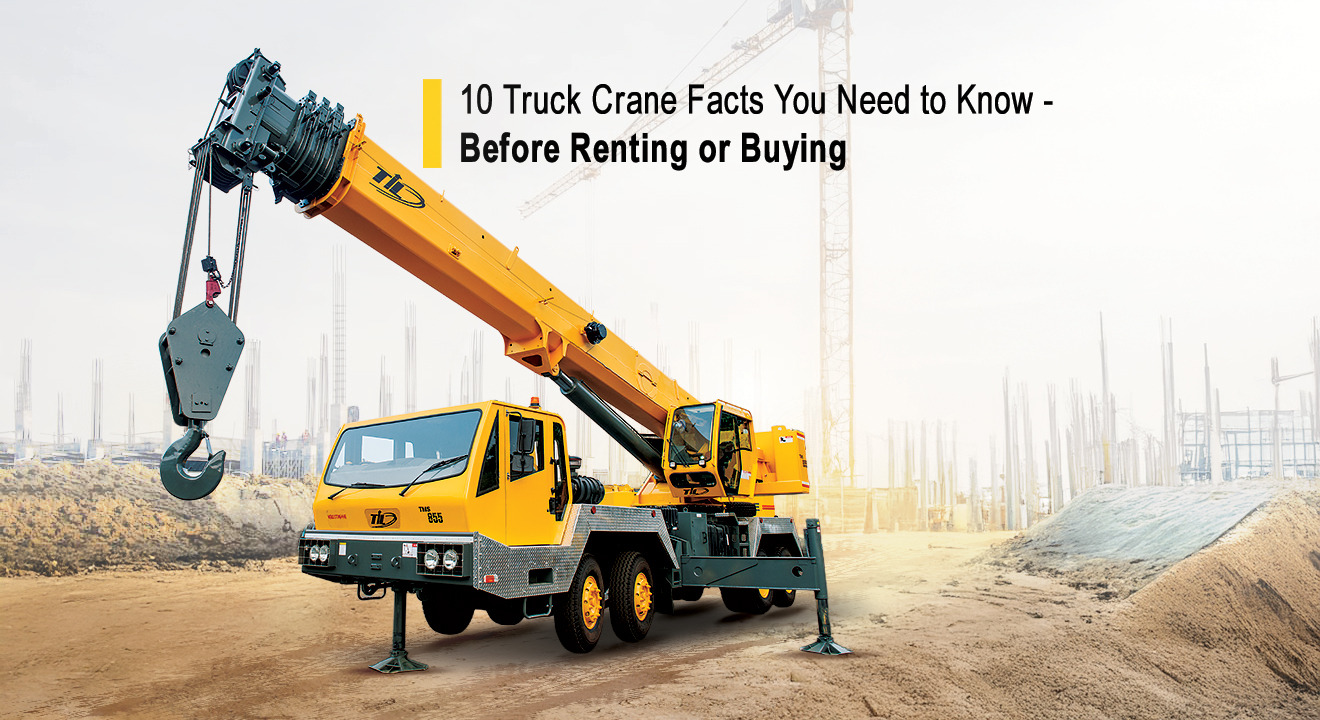
Today’s truck cranes in India combine on-road mobility with advanced lifting technology to deliver efficiency, safety, and flexibility across demanding job sites. Whether you’re planning a highway project, industrial plant installation, or mining infrastructure upgrade, understanding how these heavy-lifting machines operate and what differentiates one model from another can directly impact project timelines, safety, and cost control.
In this blog, get to know about the 10 essential truck crane facts every contractor, fleet manager, and equipment buyer should know in 2026. But, before we move ahead, you need to get to know how truck cranes differ from truck mounted crane.
Table of Contents
- Truck Crane Vs Truck-Mounted Crane In India: What’s The Difference?
- Essential Truck Crane Facts You Must Know
- Built For Fast Jobsite Mobility
- Telescopic Booms Deliver Higher Reach & Precision
- Advanced Hydraulic Systems
- Outriggers For Safe Lifting Operations
- Load Charts For Safe Lifting Limits
- Certified Operators
- Truck Cranes Reduce Cycle Time
- Better Fuel Efficiency
- Truck Cranes Are Built For Specific Use Cases
- AfterMarket Support
- How TIL Limited Is Setting A New Standard?
- Final Takeaways
Truck Crane Vs Truck-Mounted Crane In India: What’s The Difference?
In India’s construction, mining, and infrastructure sectors, the terms truck crane and truck-mounted crane are often used interchangeably. While they serve similar lifting functions, there are important differences that matter when selecting the right equipment for Indian job sites.
A truck crane in India is typically a purpose-built machine where the crane and carrier are engineered as a single unit. These cranes are designed for heavy-duty lifting, better load stability, and long operating cycles. They are commonly used in large infrastructure projects, power plants, refineries, and mining operations where high capacity and reliability are critical.
A truck-mounted crane, by contrast, is a crane installed on a standard commercial truck chassis. It offers excellent road mobility and quicker deployment, making it suitable for urban construction, utilities, and short-duration projects. However, it usually has a lower lifting capacity.
10 Essential Truck Crane Facts You Must Know
1. Built For Fast Jobsite Mobility
Unlike crawler cranes or tower cranes, truck cranes can travel on public roads. This eliminates the need for separate transport equipment and significantly reduces setup and relocation time.
If your project requires multiple lifting operations from different locations, which is quite common in the infrastructure and mining sectors, a truck crane should be in your fleet. The newly launched TMS 885 from TIL Limited has been remarkable in this regard, translating mobility into lower downtime, faster deployment, and improved project efficiency.
2. Built For Fast Jobsite Mobility
Power projects place constant and varied lifting demands. In substations, these cranes are used to install transformers, switchgear, and structural components, often in confined spaces with limited access.
Their mobility and stable carrier platforms make them suitable for sites that lack extensive groundwork. For example, the heavy-duty 8×4 carrier of the TIL TMS 885 has outriggers to provide reliable stability even on partially prepared surfaces.
The growing renewable sector further increases reliance on mobile lifting solutions. Wind, solar, and energy storage installations require cranes with long reach and consistent performance. A 5-section power boom with up to 43.8 metres of reach, and an additional 63m with lattice, supported by a 260 HP engine, ensures dependable operation where downtime can be costly.
2. Telescopic Booms Deliver Higher Reach & Precision
Modern truck cranes use hydraulically operated telescopic booms, made up of sections that extend smoothly to achieve varying working radii.
This design allows precise placement of heavy loads and is used for lifting loads, such as:
• Pre-cast concrete segments
• Steel girders
• Machinery and plant equipment
Boom length and configuration directly affect load capacity, making telescopic performance a key consideration when renting or buying a truck crane.
3. Advanced Hydraulic Systems
Hydraulics are the core of truck crane operation. From hoisting and slewing to boom extension and outrigger deployment, all these functions depend on high-pressure hydraulic systems.
Heavy-duty truck cranes now use load-sensing, multi-pump hydraulics. This helps in smooth and simultaneous operations while maintaining stability, even during complex lifts.
4. Outriggers For Safe Lifting Operations
Truck cranes rely on hydraulic outriggers to maintain balance during lifts. These are basically extendable supports which distribute load forces into the ground and prevent tipping. If the truck crane is operating on uneven terrain, then the outriggers act as a safety gear.
However, improper outrigger setup can lead to crane accidents. Thus, ensuring correct deployment is a core safety requirement on every job site.
5. Load Charts For Safe Lifting Limits
Every machine with lifting capability comes with a load chart, which marks the maximum allowable load at different boom lengths, angles, and radii. These charts are based on precise engineering calculations involving -
• Load moment
• Boom geometry
• Counterweights
• Base stability
Thus, adhering to load chart limits ensures safe crane operation. This not only protects the equipment but also the operator while maintaining structural integrity.
6. Certified Operators
If you can drive a truck, then it does not mean that you can operate a truck crane. Crane operation goes far beyond driving, and it requires proper training, experience, and a clear understanding of three core aspects that ensure safety and precision on site.
• Load chart interpretation
• Hand and radio signalling
• Emergency response procedures
AYou must have seen truck cranes operate both on public highways and in high-risk construction or mining environments. Here, the operator’s competence plays a critical role in ensuring safety, productivity, and long-term equipment life
7. Truck Cranes Reduce Cycle Time
One of the biggest advantages of buying a truck crane is that they have the ability to combine transport and lifting in a single machine. In mining and infrastructure projects, this reduces reliance on separate haulage vehicles and fixed lifting equipment. Thus, the overall result is shorter cycle times, reduced labour requirements, and lower operational costs across project phases.
8. Better Fuel Efficiency
Fuel consumption is a major cost driver in heavy equipment operations. New-generation truck cranes increasingly feature fuel-efficient engines and optimised hydraulic systems. Some models achieve fuel savings that extend duty cycles, helping contractors control operating expenses while reducing emissions. This is an important factor in long-term projects.
9. Truck Cranes Are Built For Specific Use Cases
Not all truck cranes serve the same purpose, as the capacity and configuration vary widely.
Suppose you are looking for a truck crane that is ideal for urban construction, utilities, and small industrial plants, then you must get the 10–40 ton truck cranes. However, if you are designed for bridges, large infrastructure, power plants, and mining operations, then you need 50–100+ ton truck cranes
Advanced models, such as TMS 885 from TIL Limited, also include telemetry systems, remote controls, and predictive maintenance features.
How TIL Limited Is Setting A New Standard?
TIL Limited, a leading Indian manufacturer of construction and mining equipment, introduced the TMS 885 truck crane, marking a strong return to the heavy-duty truck crane segment.
Key highlights Of The TMS 885:
• 85-tonne lifting capacity, suitable for major infrastructure and mining projects
• Five-section telescopic boom ranging from approximately 12.1 m to 43.8 m
• 260 HP engine, balancing lifting power with on-road mobility
• Road speed up to 49 km/h, enabling efficient inter-site movement
• Focus on operator comfort, safety systems, durability, and after-sales support.
The TMS-885 reflects the broader shift toward Made-in-India heavy equipment engineered for both domestic use and export markets.
Final Takeaways
Truck cranes are not just any mobile lifting machines; they are integrated engineering that streamlines transportation, lifting, and deployment into one efficient solution.
From telescopic boom design and hydraulic performance to safety systems and operator expertise, every detail matters, especially when renting or buying a truck crane in 2026.
With innovations like the TMS 885 by TIL Limited, the truck crane industry continues to evolve toward higher capacities, smarter technology, and better project economics. Understanding these facts helps contractors, fleet managers, and project owners make informed equipment decisions that improve safety, efficiency, and long-term value.
So, if you are looking for a truck crane that can reach higher, connect with TIL’s sales team.

Rima Chaudhuri
Publisher
Comments (…)
Loading comments…